

Your Renovation Is Running Late. What Are You Actually Owed?
Most renovation advice tells you how to avoid delays. Almost none tells you what happens when one hits anyway — what your contract really promises, and what you can do about it.
There is no shortage of advice about avoiding renovation delays in Singapore. Pick a licensed contractor. Choose your tiles early. Submit your permit on time. All sensible, all true, and all of it quietly assumes the delay is somehow yours to prevent.
What almost nobody writes about is the part that actually matters at week nineteen, when your keys were supposed to be handed over three weeks ago and you are still paying rent somewhere else: what are you owed?
The uncomfortable answer, for most homeowners, is nothing. Not because the law is against you, but because of what is — and isn't — written in the contract you signed.
A completion date is not the same as a promise
Nearly every renovation quotation in Singapore carries a completion date. Very few carry a consequence for missing it.
That difference is the whole game. A date with nothing attached to it is a forecast. It costs the firm nothing to miss, which means nothing in their schedule has to bend to protect it. When a supplier slips or a subcontractor double-books, the project moves. You carry the extra weeks — the rent, the storage, the family living out of boxes at your parents' place.
The clause that changes this is called liquidated damages. It sets, in advance, a specific sum the contractor pays if they hand over late. Its real value is not the money. It is that you no longer have to prove what the delay cost you — normally the hardest part of any dispute. The number is already agreed.
Go and look at your quotation now. If there is a completion date but no liquidated damages clause, your contract does not actually commit anyone to that date.
What a realistic timeline looks like
Before deciding whether you are late, it helps to know what normal is. Across the Singapore market:
- BTO flats — roughly 12 to 16 weeks of works. Fewer surprises, because nothing has to come out first.
- Resale flats — roughly 18 to 22 weeks. Hacking, rewiring and waterproofing all happen before anything that looks like design begins.
- HDB renovation permits — up to 10 working days once the correct drawings are submitted. If HDB asks for amendments, the clock restarts and nothing on site can proceed.
A resale flat taking longer than a BTO is not a delay. It is the job. A resale flat quoted at BTO timelines, on the other hand, was never going to finish on time — and that is worth catching before you sign rather than after.
Delays that are genuinely yours
Being fair about this matters, because it determines what you can reasonably ask for. Some delays sit squarely with the homeowner:
- Changing the carpentry layout after production has started
- Selecting tiles, laminates or stone late — the schedule waits on the slowest decision
- Supplying your own appliances or fittings that arrive after the install window
- Approving variation orders slowly, while the trades stand idle
A well-written contract separates these from the firm's own delays, and it should. What it should not do is treat every delay as though it fell from the sky.
If it has already gone wrong
Say the date has passed and the flat is not ready. In order of escalation:
- Put it in writing. Email, not WhatsApp voice notes. State the contractual completion date, today's date, and what remains outstanding. This single step changes most conversations, because it creates a record.
- Ask for a revised schedule with dates per trade. A firm that can produce one is managing the project. A firm that answers "next week" repeatedly is not.
- Withhold the final payment, not the progress payments. Final payment is your only real leverage. Stopping a progress payment mid-project usually stops the works instead.
- Mediation through CASE. Many contracts name this as the first formal step, and it is far cheaper and faster than court.
- Small Claims Tribunal. For claims up to $20,000, filed within a year. You do not need a lawyer, and renovation disputes are routine there.
Note how much easier every one of those steps becomes when a liquidated damages figure already exists. Without it, you are arguing about what six weeks of delay was worth. With it, you are pointing at a number both parties agreed to before anyone picked up a hammer.
The question to ask before you sign
You do not need to become an expert in construction law. You need to ask one question, and pay attention to how it is answered:
"What happens if you hand over late?"
The answer tells you almost everything. A firm that has thought seriously about its schedule will tell you exactly what happens, and show you where it is written. A firm that has not will explain why delays are unpredictable — which is true, and also not an answer.
You are not being difficult by asking. You are asking a company to stand behind a date it chose.
Where we stand on this
We will be straightforward about our own interest here: this is the reason the 90-Day Handover Challenge exists. Your handover date goes into a Renovation Works Schedule before the first day of works, and if we hand over after it, you receive 50% of your signed contract value back.
That is not generosity. It is what makes the date real. A deadline that costs us nothing to miss would eventually be missed — so we attached a cost to it, and then built the schedule around not paying it.
Whether you renovate with us or not, take the question with you. Ask every firm you meet what happens if they run late, and see who has an answer in writing.
Related Articles

24
Oct
Elderly-Friendly HDB Toilet Design: What Will Upgrades Cost
Plan the safest elderly-friendly toilet design HDB flat layout with proper seat ...

23
Oct
Home office ideas for small hdb room that make shared work easier
Discover smart home office ideas for small HDB room setups. Learn how to arrange...

22
Oct
5 layout and storage ideas for a 4-room BTO master bedroom
Plan the ideal master bedroom design for 4-room bto flats. Discover 5 practical ...

21
Oct
Small balcony design ideas Singapore homes can use for work and greenery
Discover smart small balcony design ideas Singapore homes can use to combine a c...
20
Oct
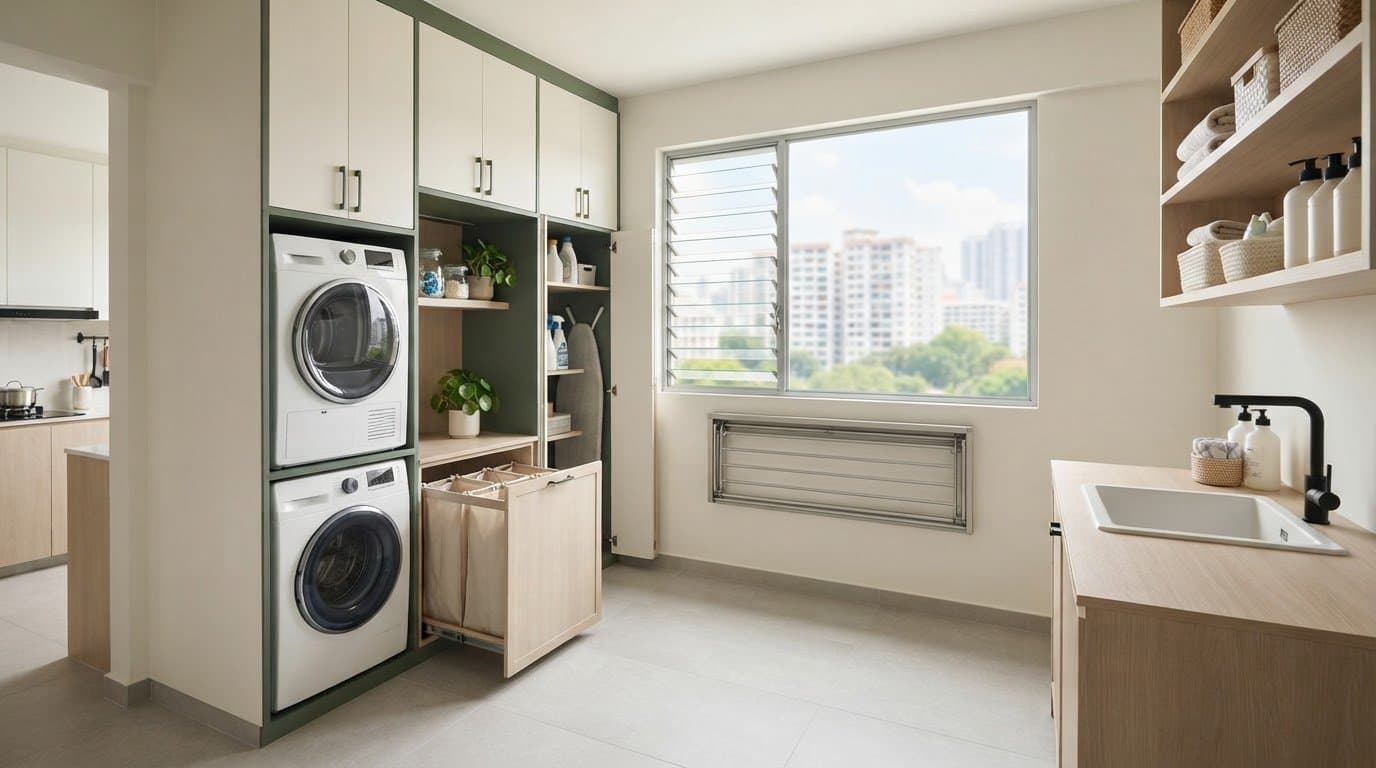
HDB Service Yard Renovation Ideas: Make Every Part of Your Space Work
Discover practical hdb service yard renovation ideas to make your laundry space ...

19
Oct
Open Concept Kitchen HDB Rules: What to Check Before You Renovate
Review open concept kitchen HDB rules before you renovate. Learn wall hacking ap...